
TUBE FITTINGS
INTRODUCTION OF TUBE FITTINGS
Discover the tube fittings, engineered with precision under rigorous quality control measures to ensure unparalleled reliability. With effortless assembly that requires no specialized tools, making connections is swift and seamless – simply insert and tighten the nuts.
Tube fittings are purposefully designed for integration within instrumentation, process, and control systems across various industries, including chemical, petroleum, power generation, and pulp and paper plants. Their versatility extends to numerous other applications where premium tube fittings are essential for optimal performance.

CONSTRUCTION OF TUBE FITTINGS
Tube fittings consist of four meticulously crafted components: the body, nut, front ferrule, and back ferrule.
When the nut is screwed onto the body, it tightens against the tapered area, compressing the tube tightly against the edge by inward curling. Positioned between the body and nut, the back ferrule plays a crucial role. As the front ferrule rolls, the back ferrule also rolls up, securely biting into the tube, ensuring a leak-free connection between the tube and the fitting.
The innovative twin ferrule design of the tube fittings ensures leak-proof sealing by transmitting assembly motion axially through the tubing. This unique approach prevents any radial movement of the tubing during assembly, preserving the tube's mechanical integrity and eliminating stress. Achieved through precise tolerance control in machining, surface smoothness, and part hardness, every component of the tube fittings contributes to this seamless integration. As a result of this meticulous swaging action, the tube fittings become mechanically integrated with the connected tube, ensuring robust and reliable performance.
TECHNICAL DATA
MATERIALS
FITTING MATERIALS
Tube fittings are crafted from a variety of durable materials, including stainless steel (typically SS316), brass, and alloy steel (such as Monel or other alloys).
SUITABLE TUBING MATERIALS
Tube fittings are compatible with various tube specifications, including stainless steel tubes meeting ASTM A269 or A213 standards, such as TP304 and TP316, or equivalent options like SUS304TP and SUS316TP according to JIS G3459. It's crucial to select the appropriate wall thickness based on operating pressure, temperature, and shock conditions. Fully annealed tubing is recommended for optimal performance, and stainless steel tubing with a Rockwell B80 hardness or less is preferred for use with the tube fittings.

Tubing
Choosing the right tubing is critical for the optimal performance of a tubing system, especially when it comes to ensuring safety, reliability, and leak-free seals with tube fittings. S-LOK tube fittings excel when paired with high-quality tubing, emphasizing the importance of considering tubing as a crucial fitting component. When making decisions about tubing material, size, and wall thickness, customers must take into account various factors such as pressure, flow, temperature, environment, and system compatibility to enhance the effectiveness and longevity of tube fittings.
General Guidelines.
-
A crucial aspect for achieving leak-free seals with tube fittings is the surface quality of the tubing. It's imperative that the tubing surface is smooth and free from scratches, draw marks, flat spots, or any dirt accumulation.
-
Welded tubing should exhibit a seamless outside diameter without any visible poor bead, ensuring compatibility and effectiveness when paired with tube fittings.
-
Thermal compatibility and corrosion resistance rely heavily on the choice of tubing and fitting material. Both tubing and material must be compatible with the process fluid, operating temperature, and environmental conditions, enhancing the reliability of tube fittings.
-
Maintaining the proper balance between tubing and fitting material hardness is essential for effective sealing. In cases where both tubing and fittings share the same material, ensuring that the metal tubing is fully annealed is vital for optimal performance of tube fittings.
-
Selecting tubing hardness in accordance with specified guidelines ensures the seamless integration and functionality of tube fittings, promoting efficient operation and longevity.
-
Avoiding extremes in wall thickness is paramount to prevent potential issues. Opting for a wall that is neither too thin, which risks collapse, nor too thick, which may impede proper deformation by the ferrule action, ensures optimal performance of tube fittings. The selection process should consider factors such as pressure, temperature, shock, and vibration to enhance the reliability of tube fittings.
When selecting tubing for use with tube fittings, several key factors should be considered:
-
Assess the quality of the tube material and the method of manufacturing to ensure reliability and performance.
-
Take into account the hardness of the tube, ensuring it aligns with compatibility requirements for tube fittings.
-
Consider the surface treatment of the tube, aiming for smoothness and cleanliness to facilitate proper sealing with tube fittings.
-
ay attention to the outer diameter (O.D) and tolerance of the tube to ensure compatibility and secure fitting with tube fittings.
-
Evaluate the wall thickness and tolerance of the tube, keeping in mind the requirements for optimal performance and durability of tube fittings.
-
Check the concentricity of the tube to ensure uniformity and proper alignment with tube fittings.
-
Assess the ovality (shape) of the tube to avoid any irregularities that may affect the fitting process or compromise the integrity of tube fittings. These considerations are essential for selecting the right tubing to complement tube fittings effectively.


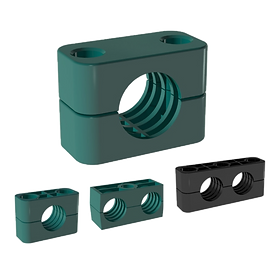
Profiled Design
Profiled Inside Surface with Tension Clearance
-
The Standard, Heavy, Twin, and Heavy Twin Series are all available.
-
Recommended for the safe installation of rigid pipes or tubes.
-
Outside diameters and nominal sizes in all popular sizes are available.
-
The grooves on the internal of the clamp bodies give a vibration/noise reduction and impact absorbing effect in the direction of the line.
-
The tube or pipe is held taut by the clearance S between the clamp halves.
-
To prevent the line from sliding, it should be utilized as a fixed point clamp.

Type H (Smooth)
Smooth Inside Surface without Tension Clearance
-
The Standard, Heavy, Twin, and Heavy Twin Series are all available.
-
Recommended for the safe installation of hoses or cables.
-
Outside diameters and nominal sizes in all popular sizes are available.
-
The hose or cable will not be damaged because to the smooth inside surface and chamfered edges.

Type RI (with Elastomer Insert)
-
The Standard, Heavy, Twin, and Heavy Twin Series are all available.
-
Recommended for the extra-cautious installation of pipes, tubes, hoses or cables.
-
Outside diameters and nominal sizes in all popular sizes are available.
-
Thermoplastic Elastomer insert with a Shore-A hardness of 73 provides the most effective reduction of vibration and noise generated by vibration.
STANDARD CLAMP BODY MATERIALS
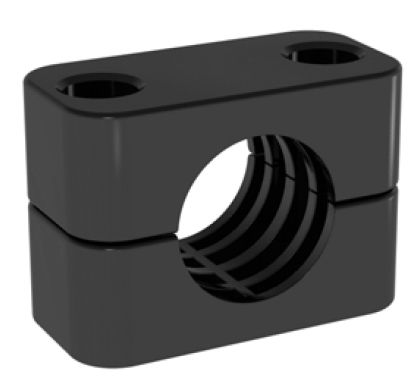
THERMOPLASTIC ELASTOMER BLACK

ALUMINIUM NATURAL
POLYAMIDE BLACK
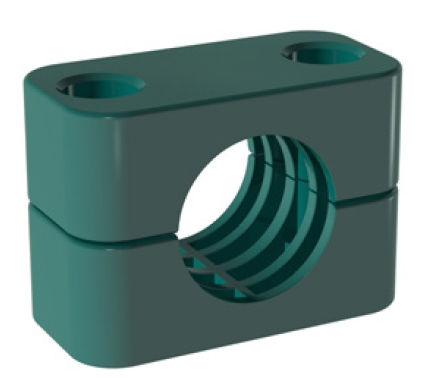
POLYPROPYLENE GREEN
METAL PARTS MATERIALS AND SURFACE FINISHINGS
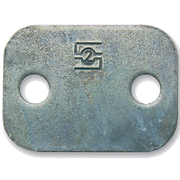
MATERIALS
SURFACE FINISHINGS
After 1200 hours in the salt spray chamber, the original STAUFF Cover Plate with Zinc/Nickel-Coating has shown no symptoms of corrosion!
All metal parts (e.g. weld plates, cover plates, bolts, rail nuts, etc.) are made of Carbon Steel unless otherwise noted (surface finishing according to material code).
Apart from that, all metal parts are supplied ex-stock in stainless steel grades:
Stainless Steel V4A
-
1.4401 / 1.4571 (AISI 316 / 316 Ti)
-
Material code: W5
Unless otherwise specified, all carbon steel metal parts come with the following standard surface finishings:
Carbon Steel, zinc/nickel-plated
-
In the salt spray test to DIN EN ISO 9227, more than 1200 hours of resistance to red rust / base metal corrosion were achieved.
-
Hexavalent chromium Cr-free (VI)
-
RoHS compliant in accordance with 2002/95/EC (Restrictions of the Use of Hazardous Substances)
-
ELV compatible in accordance with 2000/53/EC (End of Life Vehicles Directive)
-
Material code: W3
BASIC INSTALLATION INSTRUCTIONS
The tube fittings are delivered finger-tight and ready for immediate installation, eliminating the need for disassembly. This streamlined process ensures quick and hassle-free setup, enhancing the convenience and efficiency of tube fittings installation.
-
Ensure that the nut is finger-tightened securely. Insert the tubing into the tube fitting until the tube end firmly seats on the shoulder inside the fitting. This simple process ensures a snug and reliable connection with tube fittings.
-
Using a wrench, tighten the nut by 1-1/4 turn while holding the fitting body in place with a backup wrench. For ease of tracking, consider marking the nut at the 9:00 o'clock position to facilitate counting the number of turns. This marking will stop at the 12 o'clock position after completing 1-1/4 turns, ensuring proper tightening of tube fittings.

For tube fittings in sizes 1/8", 3/16", 3mm, and 4mm, only a 3/4 turn from finger-tight is necessary. This specific adjustment ensures proper tightening and secure sealing of the tube fittings, optimizing performance and reliability.
RE-ASSEMBLY INSTRUCTIONS
The tube fittings are designed for multiple uses, ensuring long-lasting performance. Before reassembly, it's crucial to ensure all components are clean and free from defects.
-
Insert the tubing with pre-swaged ferrules and a nut into the body until the front ferrule securely seats in the fitting body.
-
Hand-tighten the nut, then use a wrench to rotate the nut to the original 1-1/4 tight position (where a sharp rise in torque is felt). Finally, snugly tighten the nut with a wrench. This process ensures proper sealing and secure connection of tube fittings.
TUBE HANDLING DURING INSTALLATION
-
Exercise caution if the tubing doesn't smoothly insert into the tube fitting. It could indicate deformities like an oval shape or burrs at the tubing end. Avoid forcing it to prevent damage to both the tubing and tube fittings.
-
Ensure the use of an appropriate tube cutter and maintain a consistently sharp cutting wheel. This practice is essential for achieving clean and precise cuts, promoting optimal performance and longevity of tube fittings.
PROPER TUBE HANDLING
Adhering to good handling practices is essential for preserving the pristine surface finish of tubing supplied for use with tube fittings:
-
Avoid dragging tubing out of racks or across rough surfaces like cement, asphalt, or gravel.
-
Ensure tubing cutter wheels and hacksaw blades are kept sharp to maintain clean cuts.
-
Take care not to make deep cuts with each turn of the cutter or stroke of the saw.
-
Always deburr tube ends to prevent any rough edges that could affect tube fittings.
-
Store tubing in a manner that prevents the accumulation of dirt and contamination.
-
Consider plugging tubing ends to prevent foreign materials from entering and potentially affecting the integrity of tube fittings.
TUBE BENDING

For a leak-tight installation, it's crucial to maintain adequate linear distance between the tubing bend and tube fittings. When the tube bend is too close to the fitting, there's a risk of the deformed section entering the fitting, potentially leading to leaks. Additionally, ensure that the bending radius is not too short, as this can impact the working pressure and result in insufficient flow. Manufacturers of tube benders typically recommend a minimum bending radius to adhere to for optimal performance and integrity of tube fittings.